
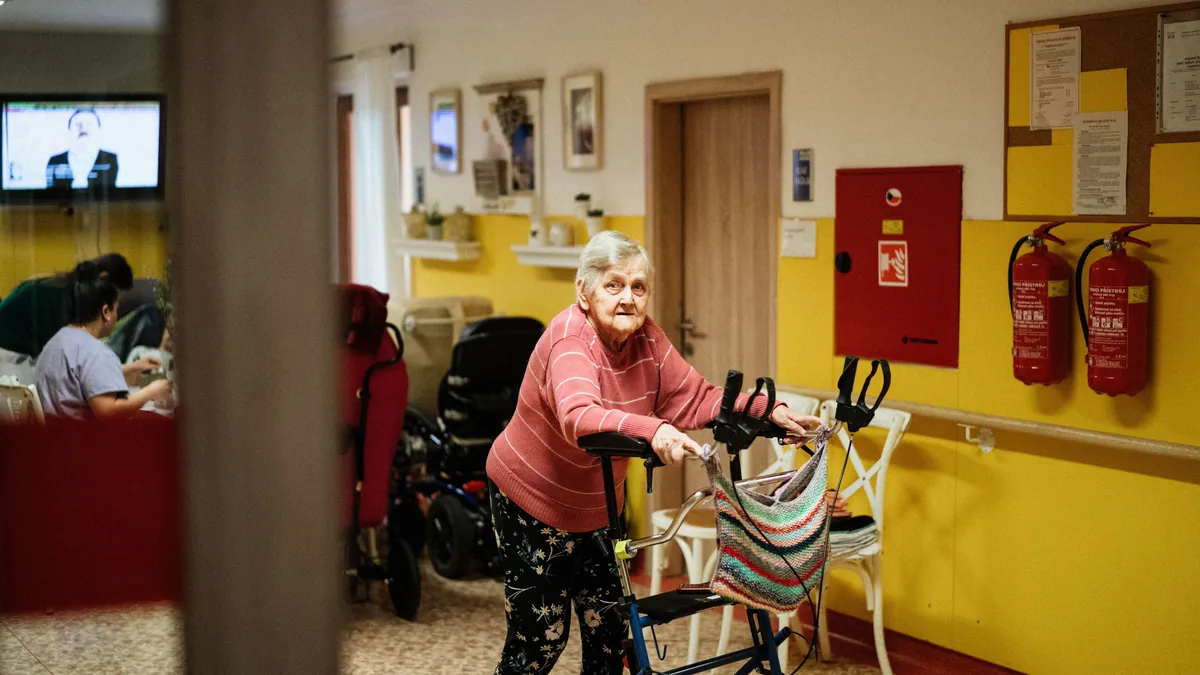
The review checks two groups of six items. The first covers wandering prevention and security: secured, alarmed exits, enclosed outdoor areas, clear signage, and staff who know which residents are at risk. The second covers safety for residents with cognitive impairment, from elopement prevention plans to monitoring and emergency call systems.
Twelve of the 189 checklist items cover wandering prevention and cognitive-impairment safety. What they are, and why signage counts as a safety measure.
Elopement is the failure mode a memory-care unit is judged on, and most of the prevention is unglamorous: doors, alarms, signage, and knowing which residents are at risk.
How do memory care units prevent wandering?
- Secured entrances and exits, for example locked doors with keypads.
- Alarm systems or monitoring devices at all exits.
- Staff awareness of residents at high risk for wandering.
- Enclosed outdoor areas that are safe for resident use.
- Emergency exit doors equipped with alarms or security systems.
- Clear signage and visual cues to help residents navigate the facility.
How are residents with cognitive impairment kept safe?
- Elopement prevention plans in place for at-risk residents.
- Rooms free of sharp objects or items that could cause harm.
- Monitoring systems, such as cameras or staff checks, for high-risk residents.
- Non-toxic, safe cleaning supplies in resident areas.
- Secure storage of medications, cleaning supplies and hazardous materials.
- Easily accessible emergency call systems in resident rooms.
Why does signage help prevent wandering?
Because a resident who cannot find their own room is a resident who will keep walking, and a resident who keeps walking is the one who finds the door. Large legible signs, visible clocks and calendars, and calm decor without disorienting patterns are prevention, not decoration. They sit in the Environmental Comfort & Design category alongside temperature and noise control, and they reduce the agitation that produces the exit-seeking in the first place.
The two failures that show up together
An elopement plan that exists on paper and a staff group that cannot name the at-risk residents is the commonest pairing. The second item on the list — staff awareness — is the one that makes the other five work.
All 40 memory care items · Well-being and cognitive enhancement.
What the evidence says
Wandering is one of the core behavioral and psychological symptoms of dementia, and “one or more of these symptoms will affect nearly all people with dementia over the course of their illness.”
A scoping review that screened 3,376 articles and included 73 identified 27 variables associated with missing incidents among people living with dementia, grouped into demographics and personal characteristics, health conditions and symptoms, and environmental and contextual antecedents. Its statement of the stakes is short: “The adverse outcomes of going missing include injuries, death, and premature institutionalization.”
What makes a missing resident more likely to be harmed?
A nationwide Swedish registry study of 1,041 police missing-person reports concerning people living with dementia found the person was harmed in 61 cases (6%), with harm ranging from lacerations to death. Male sex, no prior missing incident, cold season, time since last contact, delayed reporting and prolonged search duration were all associated with increased probability of harm — and “time was a critical factor, emerging as the strongest predictor of harm in the study.”
That is the case for an escalation protocol with a clock on it rather than a search that starts informally. It is also why the review checks staff awareness of which residents are at risk separately from whether alarms exist: the first minute is spent knowing who is missing.
Wandering and falls are the same population
An analysis of 282,518 assessments covering 75,132 long-term care residents found that unstable health, unsteady gait, wandering and moderate to severe dependency in activities of daily living were the strongest risk factors for falls, and that cognitive impairment carried a hazard ratio between 1.22 and 1.37 across the periods studied.
Frequently asked questions
Why do people with dementia try to leave?
Often because they are lost inside the building. A resident who cannot find their own room keeps walking, and a resident who keeps walking is the one who finds the door. Large legible signs, visible clocks and calendars, and calm decor reduce the disorientation and agitation that drive exit-seeking in the first place.
What should a facility do when a resident goes missing?
Act on a clock rather than start an informal search. Time was the strongest predictor of harm in a Swedish study of missing people with dementia, and delayed reporting and long searches both raised the risk. The first minute is spent knowing who is missing, which is why staff must already know which residents are at risk.
How often are people with dementia harmed when they go missing?
In a nationwide Swedish study of 1,041 police missing-person reports involving people living with dementia, the person was harmed in 61 cases, about 6%. Harm ranged from cuts to death. Going missing can also lead to injury and earlier placement in a care facility.
Are residents who wander more likely to fall?
Yes. An analysis of 75,132 long-term care residents found that wandering, unstable health, an unsteady walk and heavy dependence on help with daily activities were the strongest risk factors for falls. The residents a facility watches for elopement are largely the same residents it needs to watch for falls.
References
- Kales HC, Gitlin LN, Lyketsos CG 2015. Assessment and management of behavioral and psychological symptoms of dementia. BMJ 350:h369. [clinical review] · PMID 25731881 · doi:10.1136/bmj.h369
- Perez H, Miguel Cruz A, Neubauer N, et al. 2024. Risk factors associated with missing incidents among persons living with dementia: a scoping review. Canadian Journal on Aging. [scoping review, 73 studies] · PMID 38297497 · doi:10.1017/S0714980823000776
- Larsson M, Årestedt K, Svensson A, Andersson H, Wolmesjö M 2025. Missing incidents and the risk of harm in persons living with dementia reported to the Swedish police: a nationwide retrospective registry study. BMC Geriatrics 25(1):153. [nationwide registry study, 1,041 reports] · PMID 40045223 · doi:10.1186/s12877-025-05809-9
- Cheung G, et al. 2024. Falls risk in long-term care residents with cognitive impairment: effects of COVID-19 pandemic. Journal of the American Medical Directors Association 25(1):177-182. [observational, 75,132 residents] · PMID 38104633 · doi:10.1016/j.jamda.2023.11.006